
You’ve felt it before. You’re at the driving range, striping shot after shot. The ball flies straight, the distance looks good, and you walk away feeling ready for your weekend round.
Then Saturday comes. You step onto the first tee, hit what feels like the exact same swing — and the ball flies nowhere near where you expected. It spins too much, drops short, or curves wildly offline.
It might not be your swing. It might be your practice ball.
The Hidden Variable in Golf Balls Most Golfers Ignore
Most practice ranges use limited-flight or durable range balls designed to survive thousands of hits. These balls are often harder, spin less, and fly shorter than the premium balls you play on the course (like a Pro V1, TP5, or Z-Star).
Here is the problem:
| Practice Ball Characteristic | What It Does to Your Feedback |
|---|---|
| Lower spin | Curvatures don't align with what you'd expect on the course. |
| Reduced ball speed | Hides your real distance. |
| Harder feel | Numbs your sense of strike quality. |
| Inconsistent flight | Makes it impossible to trust your shot shape. |
When you practice with a ball that behaves differently from your gamer ball, your brain gets false feedback.
Why This Matters Even on a Simulator
You might think: "I practice indoors on a simulator. The ball doesn't matter as much because I'm just looking at numbers."
That is not correct.
Even on a launch monitor like TrackMan or Uneekor, the ball still matters. Here is why:
Spin rates are real — The simulator reads the actual spin coming off your ball. A low-spin range ball will show lower spin numbers than your real ball.
Ball speed is real — A harder range ball won't compress the same way a premium urethane ball does. Your ball speed numbers will be lower, making you chase speed that doesn't exist.
Launch and peak height are real — Different balls launch differently. Practice with the wrong ball, and you'll dial in the wrong window.
Feel transfers to the course — If you get used to the clicky, hard feel of a cheap range ball, your touch around the greens will suffer.
The simulator doesn't guess. It measures what the ball does. Garbage in, garbage out.
The Solution: Practice with What You Play
The best players in the world practice with the exact ball they play on the course. They want consistent feedback so they can trust their numbers and their feel.
But we understand: hitting Pro V1s (or your premium ball of choice) at the range can get expensive. Very expensive.
That is why OGP has done something about it.
OGP's New High-Performance Range Balls
We just updated the entire facility with new range balls that fly and feel surprisingly close to premium tour balls like a Pro V1.
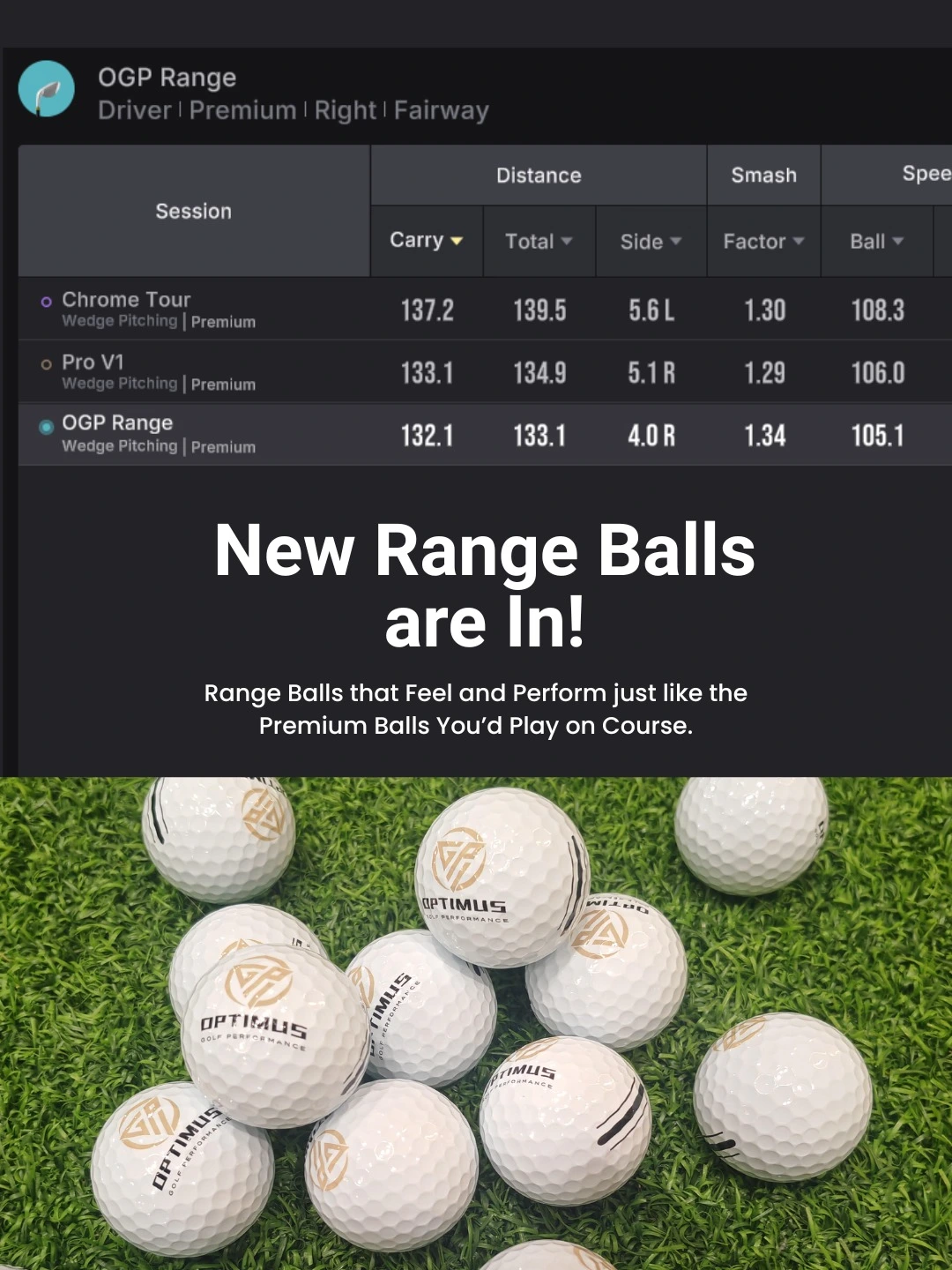
These aren't your typical rock-hard, limited-flight range balls. Our new practice balls deliver:
| Benefit | What It Means for You |
|---|---|
| Consistent flight & distance | What you see on the simulator is what you'll get on the course |
| True feedback on every shot | Your hooks, slices, and spin rates are real — no masking |
| Confident practice | Trust your numbers and your feels |
Whether you're dialing in your wedge distances, testing driver spin, or grooving a new swing change, you can now practice at OGP with confidence — knowing that the ball behaves like the one you play on Sunday morning.
Come Feel the Difference
Your practice session should prepare you for the course — not leave you guessing why your range swing doesn't travel.
Come try our new range balls at OGP. Book a bay, hit some shots, and see for yourself.
Because when your practice ball matches your play ball, your handicap has nowhere to hide.
Quick Summary
| If you practice with... | You'll learn... |
|---|---|
| Cheap range balls | False confidence |
| OGP's new high-performance range balls | True feedback that transfers to the course |
Practice smarter. Play better. Come to OGP.